Most organisations are not short of data. They are definetly not short of process.
What they are missing is the reasoning layer between the two.
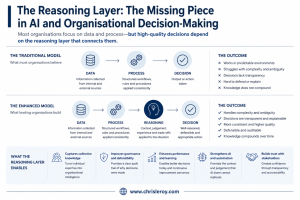
The False Model
Organisations tend to assume that better data, combined with better processes, will naturally produce better decisions. The logic appears sound: collect more information, refine workflows, and standardise execution. If each step is optimised, the outcome should improve.
This creates an implicit model of decision-making:
Data → Process → DecisionIn stable, predictable environments, this model can work reasonably well. Routine tasks, repeatable scenarios, and clearly defined rules can be handled efficiently through structured processes. It is this logic that underpins much of modern automation and digital transformation.
However, most real-world decisions do not operate under perfectly predictable conditions. They involve ambiguity, competing priorities, incomplete information, and context that cannot be fully captured in a predefined process.
When those conditions arise, the model begins to break down.
What the Reasoning Layer Actually Does
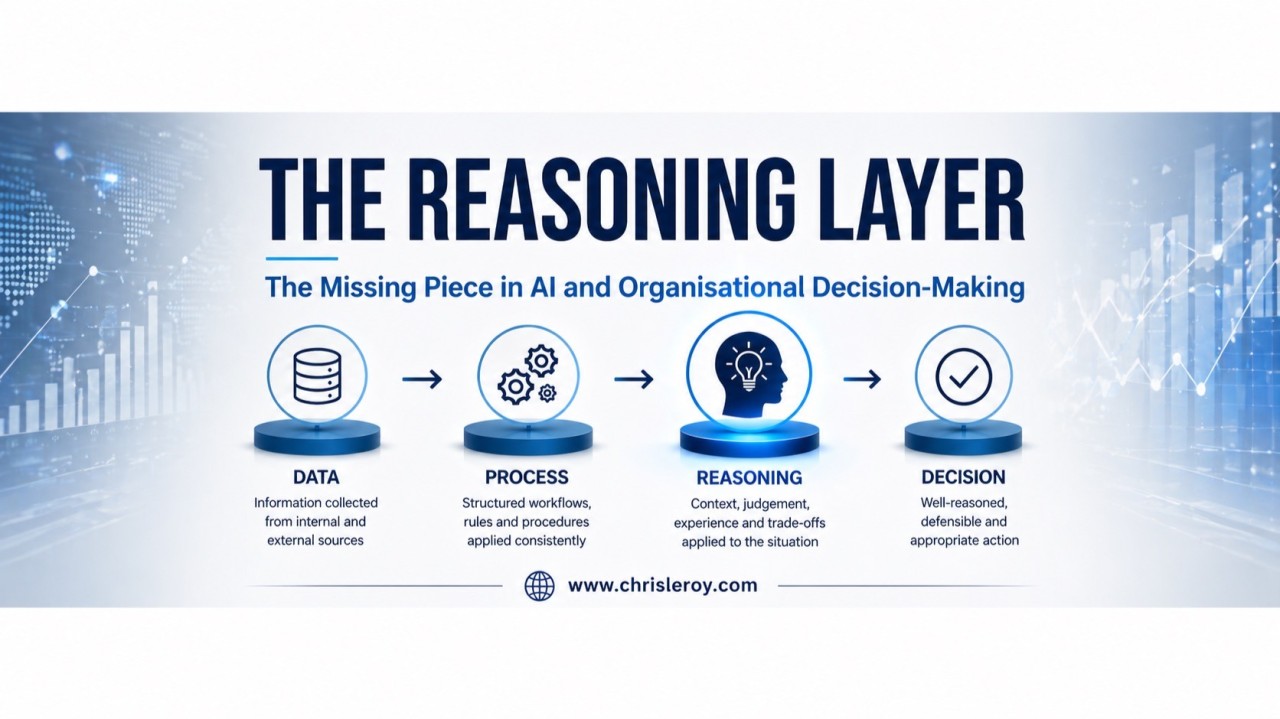
Between process and decision sits a critical, often invisible layer:
Data → Process → Reasoning → DecisionThe reasoning layer is where decisions are shaped, not merely executed.
It is where individuals interpret information, weigh competing factors, and apply judgement. It is where context is recognised—where a situation that appears routine is understood to be materially different. It is where trade-offs are evaluated, risks are balanced, and exceptions are justified.
Reasoning answers the questions that processes cannot:
- Why was this decision made instead of another?
- What alternatives were considered and rejected?
- What risks were accepted or avoided?
- What contextual factors influenced the outcome?
- What experience or prior knowledge informed the judgement?
This is not information that typically sits neatly within process documentation. It is often developed through experience, exposure to variation, and the accumulation of tacit knowledge over time. It is, in many cases, held implicitly by individuals rather than explicitly by the organisation.
Why AI Exposes the Gap
The increasing adoption of artificial intelligence is making this gap more visible.
AI systems are highly effective at processing data and executing defined processes. They can identify patterns, apply rules, and produce outputs at a scale and speed that human systems cannot match. In doing so, they reinforce the belief that the existing model—data plus process—can be extended indefinitely.
However, if the reasoning layer is not captured and incorporated, AI does not eliminate the gap; it amplifies it.
AI systems trained on outputs and workflows can replicate decisions that appear correct under normal conditions. But when confronted with situations that fall outside the expected pattern—edge cases, conflicting signals, or novel circumstances—they lack the underlying judgement required to adapt.
In effect, organisations begin to scale decisions without scaling understanding.
The result is a growing “decision gap”: outputs continue to be produced, processes continue to function, but the rationale behind decisions becomes increasingly opaque. When questions arise—internally or externally—the organisation may struggle to explain how or why a particular outcome was reached.
Why This Matters
The absence of a reasoning layer is not merely a theoretical concern; it has practical and, in many cases, legal consequences.
In regulated environments, decisions must often be justified to external parties, whether regulators, courts, or affected individuals. If a decision cannot be explained in a clear and defensible way, it becomes difficult to sustain under scrutiny.
Even outside formal regulatory contexts, the inability to articulate reasoning undermines trust. Stakeholders—customers, employees, and partners—expect decisions to be fair, consistent, and grounded in logic. When outcomes appear inconsistent or arbitrary, confidence erodes.
Internally, the impact is equally significant. Without a captured reasoning layer, organisations struggle to learn from past decisions. Knowledge does not compound; it resets. Teams revisit the same issues, make similar mistakes, and expend effort rediscovering insights that were previously understood.
Over time, this leads to increased risk, reduced efficiency, and a gradual weakening of organisational capability.
What Organisations Should Do
Addressing this gap requires a shift in focus. Organisations must move beyond capturing activity and begin capturing thinking.
At a minimum, this involves recording not only what decisions were made, but why they were made. For significant or non-routine decisions, organisations should document:
- the key factors considered
- the alternatives evaluated and rejected
- the risks identified and how they were weighed
- the contextual elements that influenced the decision
- the experience or judgement applied
This information should be structured in a way that can be accessed, analysed, and reused. Over time, it forms a body of institutional intelligence that supports consistency, improves decision quality, and enhances defensibility.
For organisations implementing AI, this becomes even more critical. Training systems on data and outputs alone is insufficient. Where possible, AI systems should be informed by structured reasoning—case histories, decision rationales, and contextual annotations that reflect how experienced professionals approach complex situations.
Finally, organisations need to recognise that reasoning is an asset. It should be treated with the same importance as financial data, operational metrics, or customer information. It is the foundation upon which effective decision-making rests.
Conclusion
The future of organisational performance will not be determined solely by how efficiently work is executed, but by how well decisions are made and explained.
Data and process remain essential. But without the reasoning layer that connects them to outcomes, they are incomplete.
The organisations that succeed will be those that can capture, articulate, and reuse how they think.
Because in the end, it is not the process that defines an organisation’s capability:-
It is the quality of its reasoning