AI Governance Was Built for Systems That Stayed Still
Way to many organisations are still approaching AI governance as though they are governing traditional software. They write the policy, approve the use case, perform the risk assessment, document the controls, and then assume the system has been brought within an acceptable governance framework. On the surface, that feels responsible because it looks like the organisation has taken control.
That approach worked reasonably well when systems behaved in predictable ways. Traditional software may be updated, patched, integrated or exposed to new vulnerabilities, but its basic function usually remains within a defined operating structure. A payroll system does not suddenly reinterpret its purpose because users are interacting with it differently, and a document management system does not quietly evolve its own patterns of reasoning as more data, prompts or behavioural signals are introduced.
Artificial intelligence changes that assumption completely. The majority of AI systems now being built, trained or deployed are not static tools in the old software sense. They are adaptive systems that learn, respond, adjust and evolve as they interact with data, users, prompts, workflows and business environments.
The Real Issue Is Morphology
The core issue is not simply that AI can make mistakes. Every system can make mistakes, and every governance model has to account for that. The deeper issue is that AI systems have a kind of operational morphology; they can change shape over time in ways that may not be immediately visible to the people responsible for governing them.
This morphology matters because the system you approve at the beginning may not be the system you are dealing with six months later. As more data is introduced, as users find new ways to interact with it, as prompts evolve, as workflows expand, and as the model is refined or connected to new sources of information, the system begins to morph. The expected outcome may no longer be exactly what was originally intended.
That is the part that static governance does not properly deal with. Static governance assumes the thing being governed remains close enough to the thing originally assessed. But if the AI system is constantly adapting, then the governance model is always at risk of governing yesterday’s version of the system.
Static Governance Creates a False Sense of Control
The danger with static governance is that it can make an organisation feel protected when it is really only protected on paper. (I recently reviewed a data policy and data assessment process for a government department and its full governance strategy was built on static review… this is truly scary) A policy may say the AI system is approved for a certain purpose, but that does not mean the system is still being used in that way. A risk assessment may have been accurate when it was written, but that does not mean it still reflects the current operating reality.
This is where organisations will get caught. They may believe they have governed the AI because they have documents, committees, controls and review dates. But while the governance framework remains fixed, the AI system may be changing through use, training, data exposure, user behaviour and growing organisational reliance.
That gap is the risk. It is the space between what the organisation thinks the system is doing and what the system is actually becoming. If nobody is watching that movement, then governance becomes little more than a historical record of what people believed the system was at the time it was approved.
AI Systems Do Not Just Operate. They Metamorphose.
This is why the language of metamorphosis matters. We are not simply dealing with tools that perform a fixed function. We are dealing with systems that can gradually become something different inside the organisation as their role expands and their outputs become more trusted.
A system may begin as a simple drafting assistant. Over time, users may start using it to identify risks, interpret patterns, summarise client histories, compare contract clauses or recommend next steps. The name of the system may not change, the interface may not change, and the original policy may not change, but the role of the system has changed significantly.
That is the metamorphosis. The tool has moved from assisting a task to influencing judgement. If the governance framework does not detect that shift, the organisation may continue treating it as low-risk administrative support when, in reality, it has become part of the decision-making environment.
Manual Review Cannot Keep Up With Constant Morphing
One of the major problems with static governance is that it relies too heavily on manual review. If the AI system is changing shape through usage, data, prompts and adaptation, then someone has to keep going back to check whether the original assumptions still hold. That is possible in theory, but it becomes extremely difficult in practice.
If the morphology of the system is shifting every day, a quarterly or annual governance review is already too slow. By the time a committee looks at the system again, the use case may have expanded, the risk profile may have changed, and the level of human reliance may have increased. Governance then becomes a process of catching up with a system that has already moved on.
That is not good enough for adaptive intelligence. A governance model that depends on periodic human inspection will struggle to keep pace with a system that is continuously evolving. The more embedded AI becomes in organisational workflows, the more obvious this problem will become.
This Is Why AI Telemetry Matters
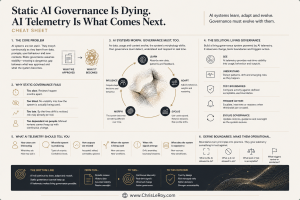
Living governance needs AI telemetry. Without telemetry, the organisation has no reliable way of seeing how the AI system is behaving, how it is being used, and whether it is beginning to move outside acceptable boundaries. It is effectively trying to govern a morphing system with a blindfold on.
AI telemetry means the system itself needs to feed meaningful signals into the governance environment. Those signals might show how users are interacting with the model, what kinds of prompts are being used, where outputs are being accepted without review, whether the system is being pushed into higher-risk areas, and whether the patterns of output are beginning to shift.
This is not about collecting data for the sake of collecting data. It is about giving governance a way to see the morphology of the system as it happens. If AI is changing, then governance needs a live feed of the signals that show how, where and why that change is occurring.
Governance Needs Boundaries, Not Just Principles
A living governance system cannot simply say, “We will use AI responsibly.” That kind of statement sounds good, but it does not tell anyone when the system has moved outside the bounds of acceptable use. Principles are useful, but they are not enough if there is no mechanism for detecting when the system has drifted away from them.
Organisations need to define operational boundaries. What is the AI allowed to do? What is it not allowed to do? What level of uncertainty requires review? What type of output requires escalation? What patterns suggest the AI is being used outside its approved purpose? What changes in data, behaviour or reliance should trigger a fresh governance assessment?
That is where living governance becomes real. It is not just a document that describes good intentions. It is a system that watches for movement, compares that movement against defined boundaries, and triggers action when the AI begins to morph beyond what was originally approved.
The Legal Sector Shows the Risk Clearly
The legal sector is a useful example because the risk is not just technical; it is professional, ethical and institutional. A law firm may introduce AI to assist with internal drafting or legal research, and at the beginning, the governance position may be clear. The tool is assistive only, lawyers must review outputs, and no final advice is produced without human judgement.
But that use can evolve very quickly. Lawyers may start using the AI to review previous contracts, identify unusual clauses, compare drafting positions, monitor legislative changes, or suggest which clients may need proactive advice. At that point, the system is no longer merely helping with words on a page. It is beginning to sit across the firm’s knowledge, reasoning and risk detection.
That is a fundamentally different governance problem. The AI has morphed from a drafting support tool into part of the firm’s operating intelligence. If the governance framework still treats it as a low-risk assistant, then the governance framework is no longer aligned with reality.
The Real Question Is: What Is the AI Becoming?
This is the question most organisations are not yet asking properly. They are still asking whether the AI system was approved, whether a policy exists, whether staff were trained, and whether the risk assessment was completed. Those questions matter, but they are not enough.
The better question is: what is this AI system becoming? That question forces the organisation to look at evolution, not just deployment. It asks whether the system has changed shape, whether its role has expanded, whether users are relying on it differently, and whether the original boundaries still make sense.
That is the heart of living governance. It does not treat AI as something frozen in time. It treats AI as something that can morph, adapt and become more influential inside the organisation than anyone first intended.
Static Governance Is Dead Because AI Does Not Stand Still
Static AI governance is not failing because governance is unimportant. It is failing because governance is too important to remain frozen while the system it governs continues to evolve. A static framework may look impressive, but if it cannot detect movement, it cannot manage risk properly.
The future of AI governance has to be living, adaptive and telemetry-driven. It needs to receive signals from the AI environment, monitor the system’s morphology, detect drift, test boundaries, trigger review and force the organisation to respond when the AI begins to move beyond what was intended or acceptable.
That is the shift organisations need to understand. We are no longer governing fixed tools. We are governing adaptive intelligence. And if the intelligence is learning, morphing and changing shape, then the governance system must be alive enough to notice.