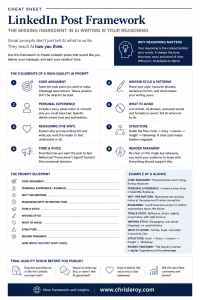
I am watching a constant barrage of criticism come in regarding the way LinkedIn Posts are being written and how the majority of posts look like they have been produced from the AI Factory line. In particular, the LinkedIn conveyor belt. More and more articles and comments have no thought and are just being churned out. Though the problem is not always the AI. The problem is the prompt and the lack of recognition that what you produce is a reflection of you as a professional . If you do not give the AI enough context about your thinking, your tone, your structure and your personal style, it will default to something polished, safe and slightly bland (let’s not kid ourselves… extremely bland).
The real power of prompting is not simply asking for content. It is teaching the AI how you think.
What is your reasoning as to why and how you write?
That means a good article prompt should not just say, “Write me an article about customer experience” or “Write me a LinkedIn post about AI.” It should give the AI the raw material behind the article: your argument, your personal experience, your emotional angle, your preferred tone, the audience you are speaking to, and the kind of response you want the reader to have.
In other words, the prompt should capture the reasoning behind the article, not just the topic.
Start With the Core Argument
Before asking AI to write anything, you need to know what you are really trying to say. This does not need to be perfect. In fact, it is often better when it is rough, because rough thinking usually contains the real human insight.
For example, instead of saying:
Write an article about why shops need to go online.
You might say:
I want to challenge the idea that physical shops are dying because people prefer online shopping. My view is that many shops are struggling because they have removed the human experience. People are not just choosing phones because technology is better. They are choosing phones because the physical experience has become boring.
That second version gives the AI something far more valuable. It gives it a point of view.
And that is what makes an article stronger. Not just information. A position.
The Missing Layer: Reasoning
The part most people leave out of a prompt is the reasoning. They will tell AI the topic. They might tell it the format. They might even tell it the tone. But they often do not explain why they want the article written that way. That “” matters.
For example, saying:
Write this in a casual, human tone.
is useful.
But saying:
Write this in a casual, human tone because my audience is tired of polished AI content, and I want the article to feel like it came from someone who has actually lived through the issue.
is far more powerful.
The second version gives the AI context. It explains the purpose behind the style. It tells the AI what the writing is trying to achieve emotionally and professionally. It is not just asking for casual writing. It is asking for trust, credibility and human connection.
Reasoning helps the AI make better choices. It affects the words it chooses, the examples it uses, the level of polish, the sentence structure, the humour, the pacing and the way the argument is framed. Without reasoning, AI has to guess. And when AI guesses, it usually defaults to safe, generic and bland.
This is why “write in my voice” is not enough. You need to explain what your voice is trying to do.
Are you trying to challenge a common belief? Are you trying to sound credible but not corporate? Are you trying to make a complex idea feel simple? Are you trying to make the reader feel slightly uncomfortable because they have not thought about the issue properly? Are you trying to use humour to soften a hard truth?
That reasoning changes the output.
It gives the AI the thinking behind the writing. And once the AI understands the thinking, it has a much better chance of producing something that sounds like it came from a person with a point of view, not a machine filling space.
In the end, reasoning is what turns a prompt from an instruction into a briefing. And that is the difference.
An instruction says, “write this.”
A briefing says, “here is what I am trying to achieve, here is why it matters, here is how I want the reader to feel, and here is the standard I need the writing to meet.” That is where better AI writing starts. Not with better words. With better reasoning.
Add Your Personal Experience
If you want the article to sound like you, you need to include something only you could have said. This might be a story, an observation, a frustration, a lesson, a conversation, or even a random moment that made you think differently. The more specific the story, the more human the article will feel.
For example:
I recently went into a dress shop in Redcliffe, Brisbane, and it was packed. What stood out was not the products, but the way the staff created an experience. There was a large change room area, staff helping customers with styling advice, and no obvious pressure to sell. It made me realise that people still go to shops when the experience is worth it.
That kind of detail changes everything. Now the AI is not writing a generic business article. It is writing from your lived experience.
That is the difference between content and thought leadership.
Define the Tone You Want
Tone matters. A lot.
If you do not define it, AI will often produce something that sounds like a corporate newsletter, a motivational speaker, or a university essay. That may be fine in some cases, but it usually does not sound like a real person. People want to feel your passion, so you need to tell the AI, what your passion is and how you want it articulated.
So, tell it how you want the article to feel. What should the reader feel when they are reading… urgency, happy, sad, confused….
For example:
Write this in a reflective but direct tone. I want it to sound like a real person thinking through an issue, not a polished corporate article. Use strong paragraphs, avoid hype, avoid clichés, and keep some of the natural roughness in the writing. It should sound thoughtful, slightly provocative, and human.
That instruction gives the AI permission not to over-polish the piece. And that matters because sometimes your “imperfections” are actually your voice. The pauses, the framing, the slight repetition, the way you build an argument — these are not flaws if they make the writing feel like you.
Give the AI Your Writing Patterns
If you want the AI to sound more like you, give it examples of how you write or describe your style.
You might say:
I usually write in paragraph form, not lots of bullet points. I like using phrases such as “I think we might be getting this wrong,” “the truth is,” “what this made me realise,” and “this is where it gets interesting.” I prefer a human, reflective style with practical insight. I do not want it to sound like a sales pitch. (which I use a lot and probably shouldn’t).
You can also paste a previous article, post or paragraph and say:
Use this as a tone reference. Do not copy the content, but study the rhythm, sentence length, structure and way the argument develops.
That is one of the most powerful things you can do. Because AI does not automatically know your voice. You have to show it.
Tell It What to Avoid
A strong prompt should include negative instructions as well.
AI has certain habits. It likes saying things like “in today’s fast-paced digital world.” It likes overusing phrases such as “game changer,” “unlocking potential,” “seamless experience,” and “embracing innovation.” It also loves turning everything into a list.
So be clear.
For example:
Avoid generic AI phrases such as “in today’s fast-paced world,” “game changer,” “unlock,” “leverage,” and “embrace.” Do not make it sound like a marketing brochure. Do not overuse bullet points. Do not make every paragraph sound perfectly balanced. Keep it natural.
This helps stop the article from sounding like everyone else’s AI-written content.
Include the Structure
Even if you want the writing to feel natural, the article still needs structure.
A good article prompt might ask for:
Start with a strong opening that challenges a common assumption. Then introduce my personal example. Then explain the broader business lesson. Then connect it to AI and customer reasoning. Finish with a strong closing about the future being both human and digital.
That gives the article direction without making it robotic.
The best structure is not always obvious to the reader, but they should feel it. The argument should move somewhere.
Explain the Reader’s Takeaway
A good article is not just about what you want to say. It is about what you want the reader to understand.
So include that in the prompt.
For example:
By the end, I want business owners to rethink the assumption that online is the only future. I want them to see that physical businesses can still thrive if they create a better human experience, and that AI should be used to understand customers better, not just automate staff away.
That tells the AI what the article is trying to achieve. It stops the writing from becoming a collection of interesting paragraphs and turns it into a deliberate argument.
A Strong Example Prompt Template
Here is a simple framework you can use.
I want you to write an article based on the following idea:
Core argument: [Explain the main point you want to make.]
My personal experience or example: [Tell the story or observation you want included.]
Why this matters: [Explain the broader lesson or issue.]
Reasoning: [Explain why you are writing in this manner]
My tone: Write in a human, reflective, direct style. Keep it thoughtful and slightly provocative. Do not make it sound like a polished corporate blog. Use natural paragraphs and keep some of my voice in it.
My writing style: I like paragraph-based writing, clear arguments, and phrases that sound like real thinking. Avoid generic AI language, hype, emojis, and too many bullet points.
Structure: Start by challenging a common assumption. Bring in my personal example early. Develop the broader argument. Connect it to the bigger issue. End with a strong final insight.
Reader takeaway: By the end, I want the reader to understand that [insert the key lesson].
Now write the article in my voice.
That kind of prompt gives AI enough to work with. It gives it your thinking, your experience, your tone and your desired outcome.
The Real Secret Is Not Better AI. It Is Better Input.
The quality of AI writing depends heavily on the quality of the thinking you give it. If you give it a shallow prompt, you will usually get shallow writing. But if you give it your observations, your reasoning, your examples, your frustration, your style and your point of view, the result becomes much stronger.
The future of writing with AI is not about handing everything over to the machine. It is about learning how to frame your thinking clearly enough that the machine can help shape it into something useful.
That is the real skill…Not just prompting for words…Prompting for your voice. More importantly, write and give the reader a reason to read your words. Because in the end, they are paying you, by giving them their time. That is a very special gift, you must always remember.
So it’s crucial… you put in some effort! You will know if your posts are getting traction, people will comment and like. That is crucial for success in social media.
One last thing: before you publish, upload your article back into AI and ask it to assess the quality of the writing. Ask it honestly:
-
Does this sound like AI?
-
Does it rely on clichés?
-
Does it feel generic, safe or predictable?
-
Would a reader actually be interested enough to keep reading?
That final review can be incredibly useful. Not to replace your judgement, but to sharpen it. Sometimes AI is very good at spotting the very patterns we are trying to avoid.