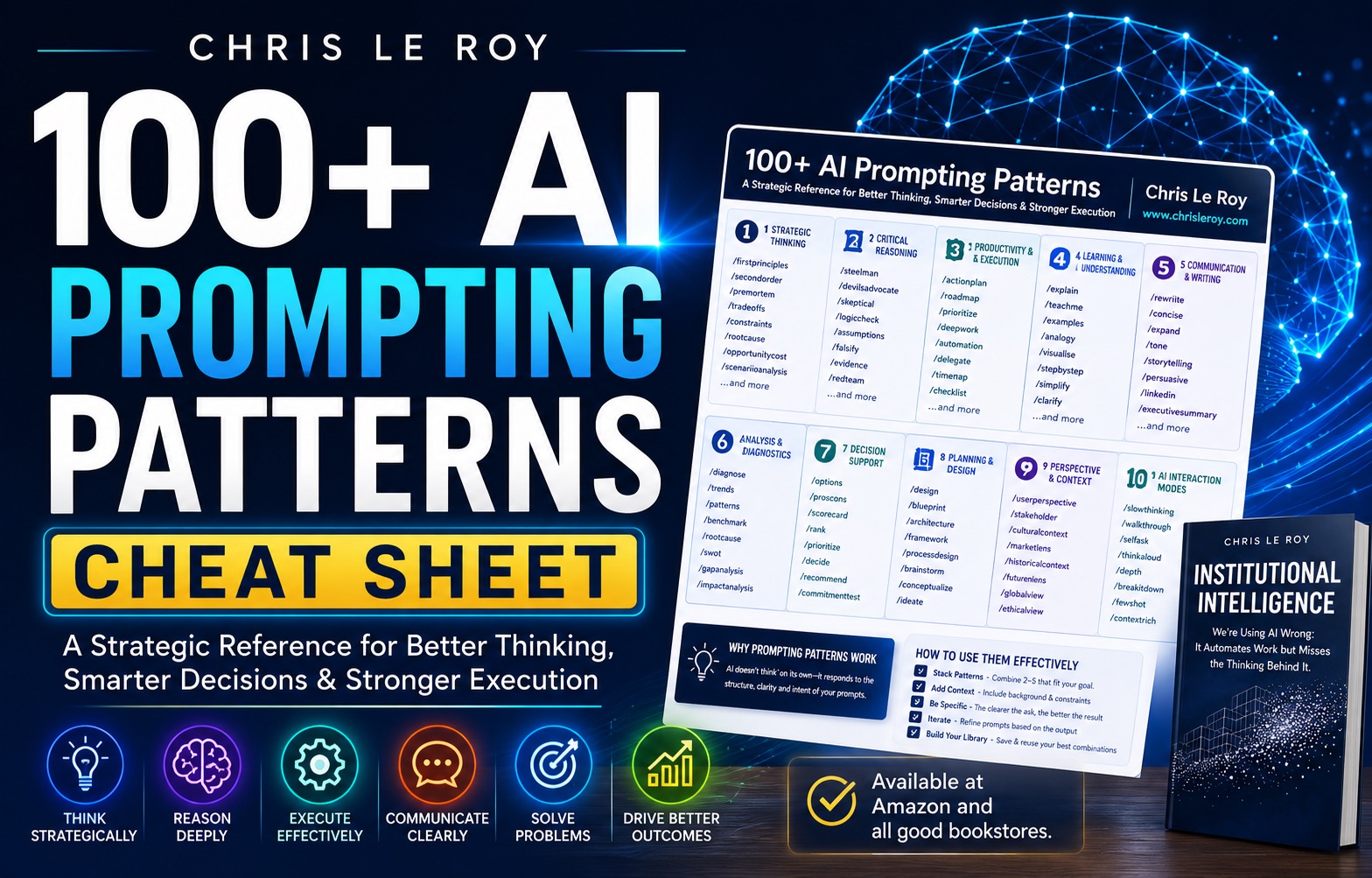
Most people approach AI as if it were a search engine. They type a question, wait for an answer, and judge the quality of the response based on whether it sounds useful. But modern AI systems do not simply retrieve information. They respond to structure, context, framing, constraints, and reasoning patterns. In many cases, the difference between a weak AI response and a highly strategic one is not the model itself … it is the way the question is asked.
That is the purpose of the 100+ AI Prompting Patterns Cheat Sheet.
The cheat sheet is designed to help people move beyond basic prompting and begin using AI as a structured thinking partner. Rather than focusing on “tricks” or hidden commands, it introduces prompting patterns that guide the AI into different modes of reasoning, analysis, planning, communication, and evaluation.
For example, a prompt such as:
“Tell me about AI in business”
will often produce a broad and generic response.
But applying prompting patterns such as:
/firstprinciples
/premortem
/steelman
/noautopilot
fundamentally changes the interaction. Instead of generating surface-level content, the AI is pushed toward deeper analysis, stronger reasoning, risk identification, assumption testing, and more strategic outputs.
The cheat sheet organises these prompting patterns into categories including:
- strategic thinking,
- critical reasoning,
- productivity and execution,
- learning and understanding,
- communication and writing,
- diagnostics and analysis,
- planning and design,
- decision support,
- perspective and context,
- and advanced AI interaction modes.
Each pattern acts as a cognitive lens. Some improve analytical depth. Others surface hidden assumptions, simplify complexity, identify trade-offs, or strengthen communication. When combined together, these patterns allow users to design more sophisticated interactions with AI systems.
Importantly, these are not “magic commands.” They are reasoning frameworks expressed in prompt form. They work because large language models respond strongly to context and intent. By shaping the structure of the request, users influence how the AI allocates attention, explores possibilities, evaluates information, and constructs responses.
The practical implications are significant.
Professionals can use these patterns to:
- improve strategic planning,
- strengthen business analysis,
- generate better reports,
- accelerate research,
- challenge weak assumptions,
- design systems and workflows,
- improve learning,
- and create more persuasive communication.
Students can use them to deepen understanding and structure thinking. Teams can use them to improve collaboration, brainstorming, and decision-making. Content creators can use them to generate more original and thoughtful material rather than repetitive AI-generated noise.
In many ways, the cheat sheet represents a shift from “prompt engineering” toward something more important: cognitive architecture. It is less about finding the perfect sentence and more about intentionally designing how AI participates in thinking processes.
As AI becomes increasingly integrated into business, education, law, government, and everyday work, the ability to structure effective AI interactions may become a core professional skill. The people who gain the greatest value from AI will likely not be those who simply ask more questions, but those who learn how to shape reasoning, context, and evaluation deliberately.
The 100+ AI Prompting Patterns Cheat Sheet is ultimately designed to help people do exactly that.
Better prompts lead to better thinking. Better thinking leads to better decisions. And better decisions lead to better outcomes.
Dowdload Your Cheat Sheet Here … Click Here (No email registration required)