Most organisations now understand that artificial intelligence requires ethical oversight. They have published principles, drafted internal policies, and adopted language around fairness, transparency, accountability and human-centred design. These commitments are important, but they are no longer enough.
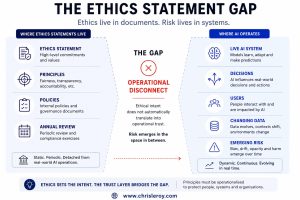
The challenge is not that organisations lack ethical statements. The challenge is that many of those statements remain disconnected from how AI systems actually operate. They sit in governance documents, strategy papers and policy frameworks, while the systems themselves continue to evolve inside live operational environments.
AI changes the nature of governance because it is not static. Once deployed, AI systems can influence decisions, shape behaviour, interact with users, and respond to changing data and context. They do not simply execute fixed instructions in the way traditional software systems do. They operate within dynamic environments where risk can emerge gradually and often invisibly.
This creates a gap between ethical intention and operational control. An organisation may say it values transparency, but still deploy systems that are difficult to explain. The inherent nature of AI Models, is to operate as black box systems. So a organisation may commit to fairness, while relying on data shaped by historical bias. It may speak about accountability, while leaving responsibility spread across vendors, technical teams, business units and decision-makers.
That gap is where AI risk lives.
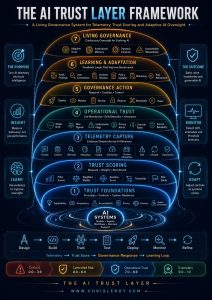
The next stage of AI governance cannot rely on principles alone. It requires an operational layer that turns those principles into measurable, observable and enforceable controls. Trust needs to move from policy language into system design, workflow governance, monitoring, review and intervention.
This is the purpose of an AI Trust Layer.
A trust layer sits between AI systems and real-world decision-making. It provides the structure needed to assess whether systems are explainable, defensible, fair, transparent, accountable, privacy-preserving and human-centred. More importantly, it allows those qualities to be monitored over time, rather than assumed at the point of deployment.
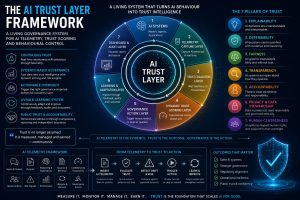
This matters because an AI system can perform well and still create risk. It can be accurate without being explainable. It can be efficient without being fair. It can scale quickly while weakening accountability. Performance metrics alone do not tell an organisation whether a system can be trusted.
Trust must therefore become measurable. Organisations need ways to score trust, detect bias, monitor drift, and identify when systems require review, redesign or removal. Governance must become continuous rather than periodic. Oversight must become embedded rather than external.
This is a major shift. It moves AI governance away from static compliance and towards operational trust. It treats governance not as a document produced before deployment, but as an active system that follows AI throughout its lifecycle.
The organisations that succeed with AI will not simply be those with the most powerful models. They will be the organisations that can demonstrate that their systems are understandable, controllable and accountable in practice.
AI does not need more ethics statements. It needs trust infrastructure. And that is the role of the AI Trust Layer.