 The Organisations That Win Will Not Be the Ones With the Most Data… But the Clearest Signals.
There’s a level of cognitive overload building inside organisations right now that I honestly don’t think we fully appreciate yet.
Most people are already operating inside a constant stream of emails, Teams messages, dashboards, reports, spreadsheets, notifications, meetings, project systems, workflow tools and operational updates… and then we layer more systems on top of that and somehow expect visibility to improve. In reality, what often happens is the opposite. The volume increases faster than a person’s ability to process it.
And the dangerous part is that operational blindness rarely looks like silence anymore.
It looks like noise.
Important signals become buried under reporting layers, duplicated systems, fragmented updates and endless streams of operational activity. People become reactive because they’re spending more time filtering information than understanding it. Teams start manually stitching together operational awareness from multiple systems, emails and conversations just to understand what is actually happening. Leadership receives dashboards with so much information packed into them that the genuinely important issues become harder to identify, not easier.
I think this becomes even more important as organisations begin introducing AI into operational environments.
Because if AI simply produces more output… more reports, more summaries, more notifications, more dashboards and more information… then there’s a real risk we accelerate the overload problem rather than solve it. The technology itself isn’t the issue. The issue is whether the information being produced is actually helping people think more clearly and make better operational decisions.
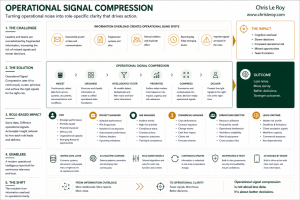
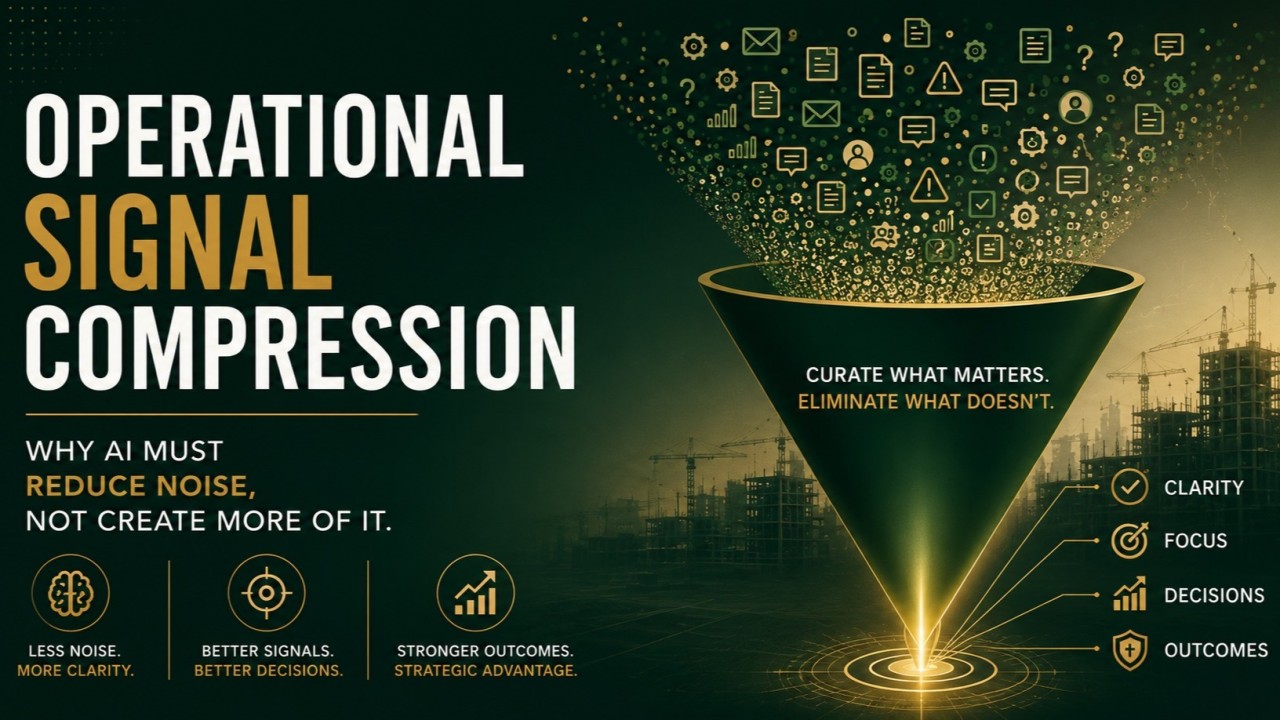
That’s where I started thinking about this concept of Operational Signal Compression.
The idea is fairly simple. The role of AI shouldn’t just be generating information. Its role should increasingly be curating operational awareness. Taking fragmented operational data from multiple systems and continuously compressing it into prioritised, role-specific, decision-ready visibility for the people who need it most.
Not everybody needs to see everything.
In fact, that’s probably one of the biggest mistakes organisations make when designing reporting environments. They assume visibility means showing more information. But operational visibility is not about volume. It’s about relevance. A CEO, project manager, lawyer, partner, HSE coordinator or operational supervisor all require different operational signals because they are making different decisions and carrying different responsibilities.
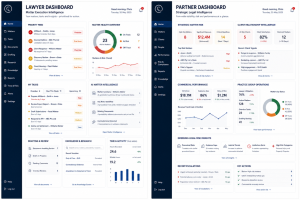
Recently I was experimenting with some conceptual dashboards for legal environments, for a job application for a legal firm here in Brisbane, and it became really obvious how differently operational intelligence needed to be curated depending on the role. Having worked in class actions, discovery, and civil litigation I started devising ways on how a junior lawyer may need visibility over procedural deadlines, overdue tasks, drafting bottlenecks, discovery backlogs, client response delays and emerging matter risks (this is something I wish I had in the workplace). The environment needed to function almost like a matter execution intelligence board… helping stay operationally stable across multiple active matters without drowning in unnecessary information.
Then I compared that with a conceptual dashboard for a partner lawyer.
Completely different operational signals.
The partner wasn’t focused on task execution in the same way. Their visibility needed to focus more on strategic matter risk, client relationship pressure, commercial exposure, workflow instability, team utilisation, escalation visibility and practice group performance. Same organisation. Same underlying operational data. Completely different intelligence requirements because the operational responsibilities were different.
I started playing around with dashboard concepts around this idea and what became interesting very quickly was realising the value wasn’t really the dashboard itself. The value was the curation layer sitting underneath it. The operational filtering. The compression. The prioritisation. The reduction of noise before the information ever reached the user.
Because once you remove that curation layer, the dashboard just becomes another overwhelming reporting surface.
Then I shifted away from the legal environment and started exploring the same idea inside a civil construction and operational setting (Yes, yet another job application). Again, the operational signals changed dramatically depending on the role. A CEO required visibility over project instability, commercial exposure, workforce pressure, operational bottlenecks and emerging delivery risk across the organisation. A project manager needed unresolved RFIs, variation exposure, subcontractor coordination issues and delivery blockers surfaced quickly. HSE required recurring incident patterns, overdue actions, compliance visibility and operational risk escalation.
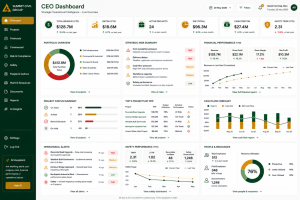
CEO Dashboard
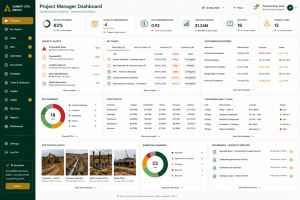
Project Management Dashboard
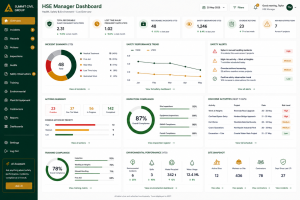
HSE Manager Dashboard
Same principle again.
Different operational signals. Different operational pressures. Different cognitive load requirements.
And what became really obvious during those exercises was that the future value of AI may not actually be about automation first. It may be about operational curation. About continuously ingesting fragmented operational information from systems, emails, workflows, reports and documents (essentially vast lakes of data) … then intelligently filtering, prioritising and surfacing the ….right operational awareness … to the …. right role … at the …right time.
That’s why I keep coming back to the idea that these environments need to function more like living systems than static reporting systems.
Traditional reporting often feels historical. It captures what happened. But operational intelligence environments should feel alive. Continuously updating. Continuously reprioritising. Continuously monitoring for emerging instability, workflow friction, escalation patterns and operational risk as information changes across the organisation.
The dashboard itself is really only the surface layer.
The real value sits underneath it… in the operational intelligence engine (OIE) constantly deciding:
- what matters
- what changed
- who needs to know
- what can wait
- what represents noise
- and what represents genuine operational signal
Because ultimately, operational visibility is not about giving people more information. It’s about reducing the cognitive effort required to understand what actually matters.
And honestly… I think that becomes one of the most important AI problems organisations will face over the next decade.