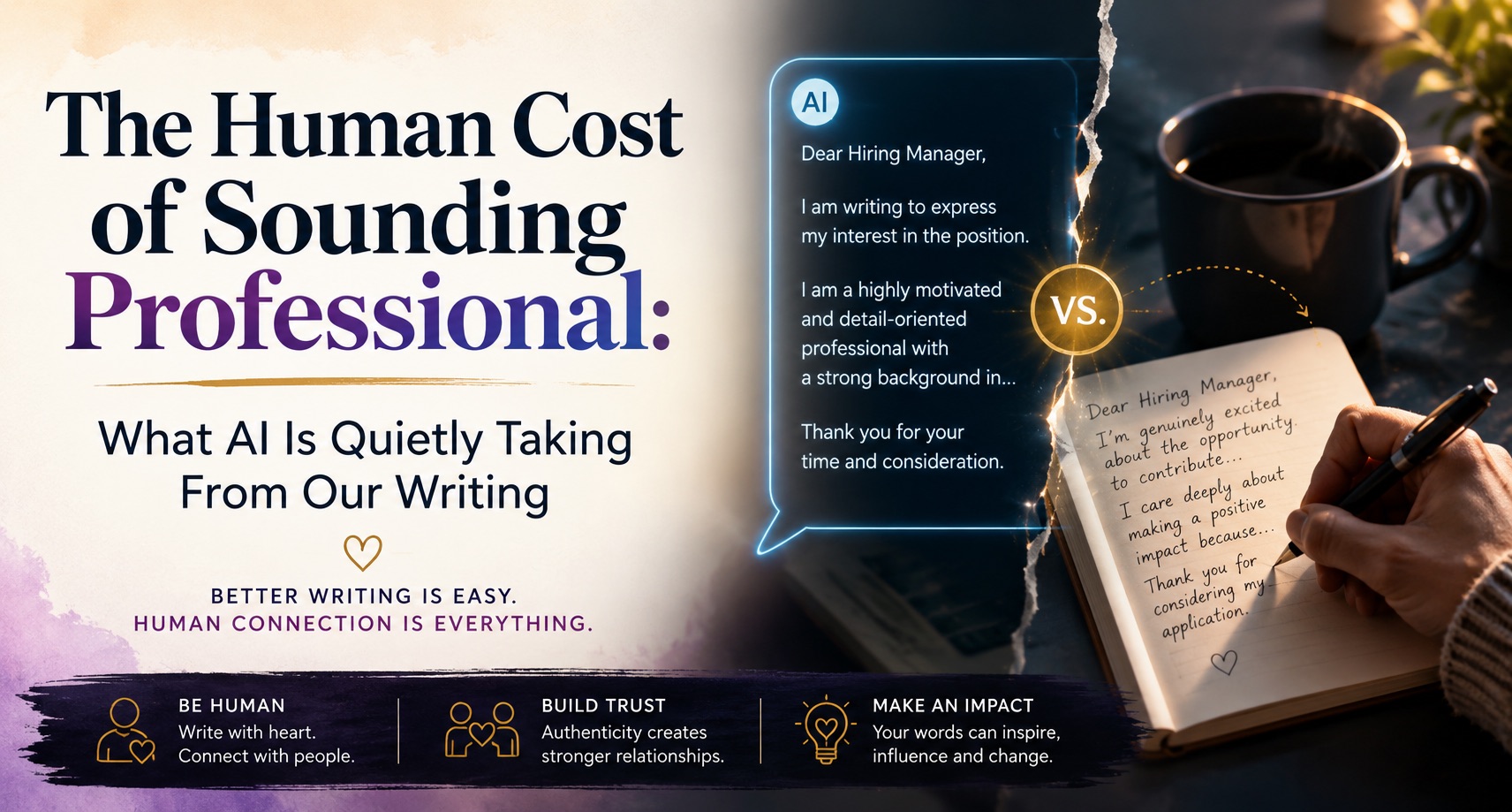
What I’ve realised recently is that we may be automating away the very thing that makes human communication matter.
Over the last few months, like many people, I’ve been using AI heavily. Writing emails. Refining resumes. Structuring cover letters. Improving website copy. Tightening descriptions. Making things “sound professional.” And in many ways, the technology is incredible. What used to take hours can now take minutes. The problem is that somewhere along the way, I think I started losing my own voice inside the process.
Everything began sounding polished… but disconnected.
It is strange because on the surface the writing often looks better. Cleaner. More corporate. More efficient. But recently I started noticing something uncomfortable. The more “perfect” the writing became, the less human it felt. The warmth disappeared. The imperfections disappeared. The personality disappeared. It stopped sounding like a person speaking to another person and started sounding like a system optimising language patterns.
And I think people feel that, even if they cannot explain it.
The real wake-up call for me came while working through job applications. I had been refining resumes and cover letters, trying to make them sound professional, more polished, aligned to what organisations supposedly wanted. Yet despite all the refinement, the connection was not happening. I was getting knock back after knock back. Something was missing.
Then over the last few days, I changed my approach completely.
Instead of trying to sound corporate, I started writing more like… me. I started allowing the human side back into the writing. I stopped trying to remove personality from the process. I started speaking honestly about why I cared about certain work, why certain areas mattered to me, what I had learned, what I believed, what connected me to the role.
And suddenly I realised the problem was not that the writing was “bad” before.
It was that it had become emotionally sterile.
That revelation hit me harder than I expected because I think this problem is becoming much bigger than resumes or emails. I think we are starting to see it everywhere. LinkedIn posts. Website copy. Marketing. Corporate communication. Even creative writing. Everyone is using AI to sound more polished, but in doing so we are slowly flattening the individuality out of human communication itself.
We are losing texture.
We are losing relatability.
We are losing the small imperfections that make people trust us.
Ironically, in our rush to sound more intelligent, we are often becoming less emotionally intelligent.
And this is where I think the conversation around AI becomes much deeper than productivity tools or automation. I have spent a lot of time talking about AI reasoning, governance, telemetry and explainability, but what I had not fully appreciated until now is that human-centredness itself may become one of the most important governance issues of all.
Because if AI starts mediating the majority of human communication, then preserving humanity inside those interactions matters.
A lot.
The issue is not whether AI can write well. Clearly it can. The issue is whether we are teaching it to preserve human connection or simply optimise for corporate polish. Those are two very different things. One builds relationships. The other builds distance disguised as professionalism.
And I think this applies directly to agentic AI systems as well.
If future AI agents are interacting with customers, clients, patients, employees or citizens, then emotional texture, empathy, nuance and relational understanding cannot simply be treated as cosmetic extras. They become part of the trust architecture itself. If that humanity layer disappears, people may still receive answers, but they stop feeling seen.
That changes everything.
For me personally, this has been a genuine wake-up call. Even with my own books, websites and articles, I can now see moments where I chased “better writing” instead of more human writing. And they are not the same thing.
The future probably does involve AI helping us write faster, structure ideas better and communicate more clearly. But I think we need to be very careful not to optimise away the humanity in the process. Because at the end of the day, business is still human. Trust is still human. Relationships are still human.
And maybe the real skill moving forward is not simply learning how to use AI…Maybe it is learning how to remain human while using it.