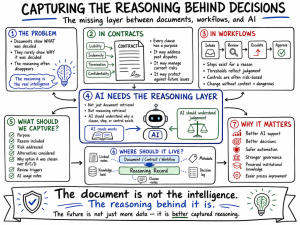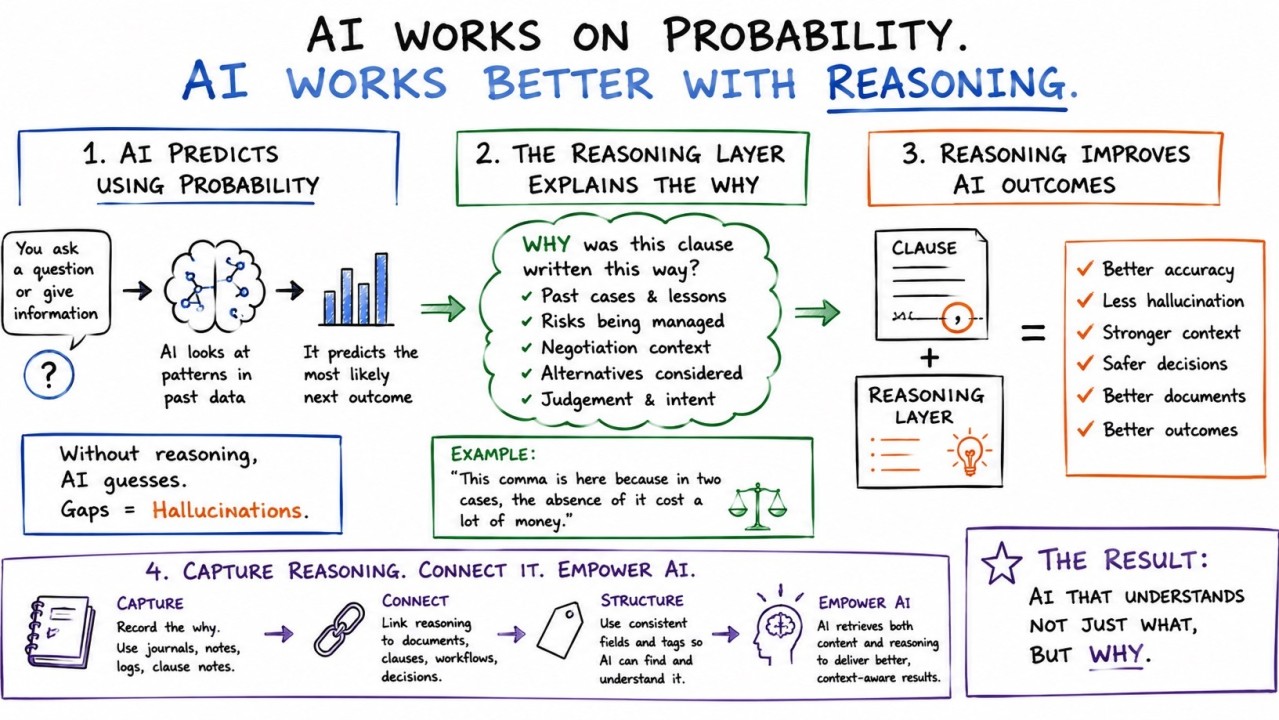
We keep talking about AI as if the document is the knowledge. But it isn’t. The document is usually just the final visible output of a much deeper thinking process.
A contract clause does not appear by accident. A workflow step is not added for fun. A policy requirement is not inserted because someone needed more words on the page.
There is usually a reason.
A clause may exist because of a past dispute. It may protect against a future risk. It may reflect a current commercial concern. It may respond to a regulatory requirement. It may preserve leverage. It may close a loophole. It may simply be there because someone, somewhere, got burned before.
But once the clause is placed into the contract, the reasoning often disappears.
And that is a serious problem.
Because the reasoning is the real intelligence.
The document tells us what was decided. The reasoning tells us why it was decided.
And if we want AI to genuinely assist in legal work, business workflows, governance, risk management, process improvement, or decision support, then we need to stop only capturing outputs.
We need to start capturing the reasoning layer behind them.
The clause is not the knowledge
Take a contract. Each clause has a function, but that function is not always obvious from the wording alone.
A limitation of liability clause may exist because the client has previously been exposed to excessive claims.
An indemnity may be drafted broadly because the other party controls the operational risk.
A termination right may be included because there is concern about future non-performance.
A notice clause may look administrative, but it may exist because a previous dispute turned on whether notice was properly given.
A confidentiality clause may not just be about secrecy. It may be about protecting commercial strategy, intellectual property, client lists, pricing models, or sensitive negotiations.
But the contract itself rarely explains all or any of this. And it probably should not.
You do not want every piece of internal reasoning embedded directly into the final legal document. That could create privilege issues, negotiation problems, interpretive risk, or unnecessary disclosure.
But if the reasoning is not captured somewhere, then it is lost.
The next lawyer may not know why the clause was there. The business may not know which risk it was designed to manage. The AI system may summarise the clause perfectly and still miss the entire point.
That is the danger.
AI may understand the words but not the judgement behind the words.
The same problem exists in workflows
This is not just a legal drafting issue.
It applies to workflows as well.
A workflow may say:
- Step 1: Intake matter.
- Step 2: Categorise matter.
- Step 3: Check risk level.
- Step 4: Escalate if threshold is met.
- Step 5: Generate report.
- Step 6: Send for review.
But why does the workflow run that way?
- Why is the risk threshold set at that level?
- Why does one matter get escalated and another does not?
- Why does the lawyer review at step 5 rather than step 3?
- Why does the system collect certain information and ignore other information?
- Why was the approval pathway designed this way?
- Why did we choose A instead of B, C or D?
That reasoning matters.
Because when someone later wants to improve the workflow, automate it, challenge it, audit it, or rebuild it with AI, they need to know more than the process map.
They need to know the thinking behind the process map. Otherwise, they risk optimising the wrong thing.
They may remove a step that looked inefficient but was actually protecting against a major risk.
They may automate a decision that was deliberately kept human because it required judgement.
They may simplify a workflow that only looks complex because it was designed to handle exceptions, disputes, regulatory exposure, or operational reality.
Again, the workflow is not the intelligence.
The reasoning behind the workflow is the intelligence.
AI needs access to the reasoning layer
This is where most AI implementation becomes shallow.
Organisations often think the answer is to give AI access to more documents.
- Policies.
- Contracts.
- Guides.
- Procedures.
- Templates.
- Matter notes.
- Training material.
- Knowledge bases.
That helps, but it is not enough.
Because AI can retrieve the document and still not understand why the document was built that way.
The next stage is not just document retrieval. It is reasoning retrieval.
Imagine asking an AI system:
“Why do we include this clause?”
And instead of merely summarising the clause, it says:
“This clause was included because the organisation previously experienced delayed payment disputes in similar contracts. The clause is intended to create a clear payment trigger, reduce ambiguity around invoice timing, and support recovery action if payment is withheld.”
That is different.
Or asking:
“Can we remove this approval step from the workflow?”
And the AI responds:
“This step was added after several high-risk matters were incorrectly categorised at intake. Removing it may reduce processing time, but it also removes the control designed to catch classification errors before advice is issued.”
That is not just AI reading.
That is AI understanding institutional reasoning.
So where do we capture the reasoning?
This is the practical question.
If the reasoning should not sit inside the final contract or the final workflow diagram, where does it go?
I think we need a separate reasoning layer.
Not hidden in people’s heads. Not buried in email chains. Not scattered across Teams messages. Not left in someone’s memory until they leave the organisation.
A proper reasoning layer could sit beside the document, workflow, policy, clause, decision, or system design.
For example, each clause in a contract template could have a linked reasoning note:
Clause:Limitation of liability
Purpose:Limits financial exposure if a claim arises.
Reason included:Prior contracts created uncapped exposure. This clause is designed to align liability with commercial value and risk appetite.
Risk addressed:Excessive damages, open-ended claims, disproportionate liability.
When to review:If the counterparty has high operational control, if statutory obligations apply, or if the contract value is unusually high.
AI usage note: Do not recommend removal without checking risk appetite, insurance position, bargaining strength, and statutory constraints.
That is useful.
For workflows, the reasoning record might look like this:
Workflow step:Senior review before advice is issued
Purpose:Quality control and risk management
Reason included:Matters in this category often involve legal uncertainty or reputational sensitivity.
Risk addressed:Incorrect advice, inconsistent position, escalation failure.
Alternative approaches considered:Automated approval, peer review, random audit
Why this approach was chosen:Senior review was preferred because risk is concentrated in a small number of complex matters.
Review trigger: If matter volume increases, review time becomes excessive, or error rates fall below an acceptable threshold.
Now the organisation has captured the reasoning. And AI can use it.
This changes how we think about legal and business knowledge
Most organisations treat knowledge as content.
- Documents.
- Templates.
- Policies.
- Procedures.
- Precedents.
- Guides.
But knowledge is not just content.
Knowledge is also the judgement that explains why the content exists. That is what gets lost when people leave. That is what gets missed when AI is trained only on documents. That is what gets forgotten when systems are redesigned without understanding the original decision logic.
And that is why so many transformation projects fail.
They map the process. They digitise the form. They automate the task. They build the dashboard.
But they do not capture the reasoning.
So when the system changes, the organisation loses the very thing that made the original process defensible.
The future is not just better prompts
A lot of people are still focused on prompt engineering. That matters. But prompts are not enough.
The better question is:
What reasoning has the organisation captured for the AI to work with?
Because if the reasoning is missing, the AI is forced to infer. And inference is dangerous when the stakes are high.
In legal work, governance, compliance, risk, contract management, workplace decision-making, public administration, and financial systems, we cannot just ask AI to guess why something was done.
- We need a record.
- We need a reasoning trail.
We need to know:
- Why was this clause used?
- Why was this workflow designed this way?
- Why was this decision made?
- Why was this risk accepted?
- Why was this control added?
- Why was this option rejected?
- Why did we choose A instead of B, C or D?
That is the missing layer.
Institutional Intelligence is reasoning made available
This is where Institutional Intelligence becomes critical. Institutional Intelligence is not just storing information.
It is capturing the thinking, judgement, experience, and reasoning that sits behind decisions.
It is the difference between:
“Here is the contract.”
And:
“Here is the contract, here is why each key clause exists, here is the risk it manages, here is when it should be reviewed, and here is what AI must understand before suggesting changes.”
That is a much more powerful system.
- It turns AI from a document assistant into a reasoning assistant.
- It gives future workers context.
- It gives leaders better decision trails.
- It gives organisations a way to preserve judgement.
And it gives AI something far more valuable than raw text.
It gives the AI access to why.
The real question
So maybe the next phase of AI is not just about connecting it to more data.
Maybe it is about connecting it to better reasoning.
Because the organisations that win with AI will not just be the ones with the most documents, the most dashboards, or the most automated workflows.
They will be the ones that can answer one simple question:
Why did we do it this way?
And if they can capture that answer clearly, consistently, and in a way AI can use, they will have something far more valuable than a knowledge base.
They will have a reasoning base. And that may become one of the most important assets an organisation can build.