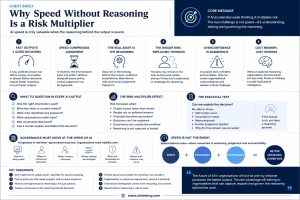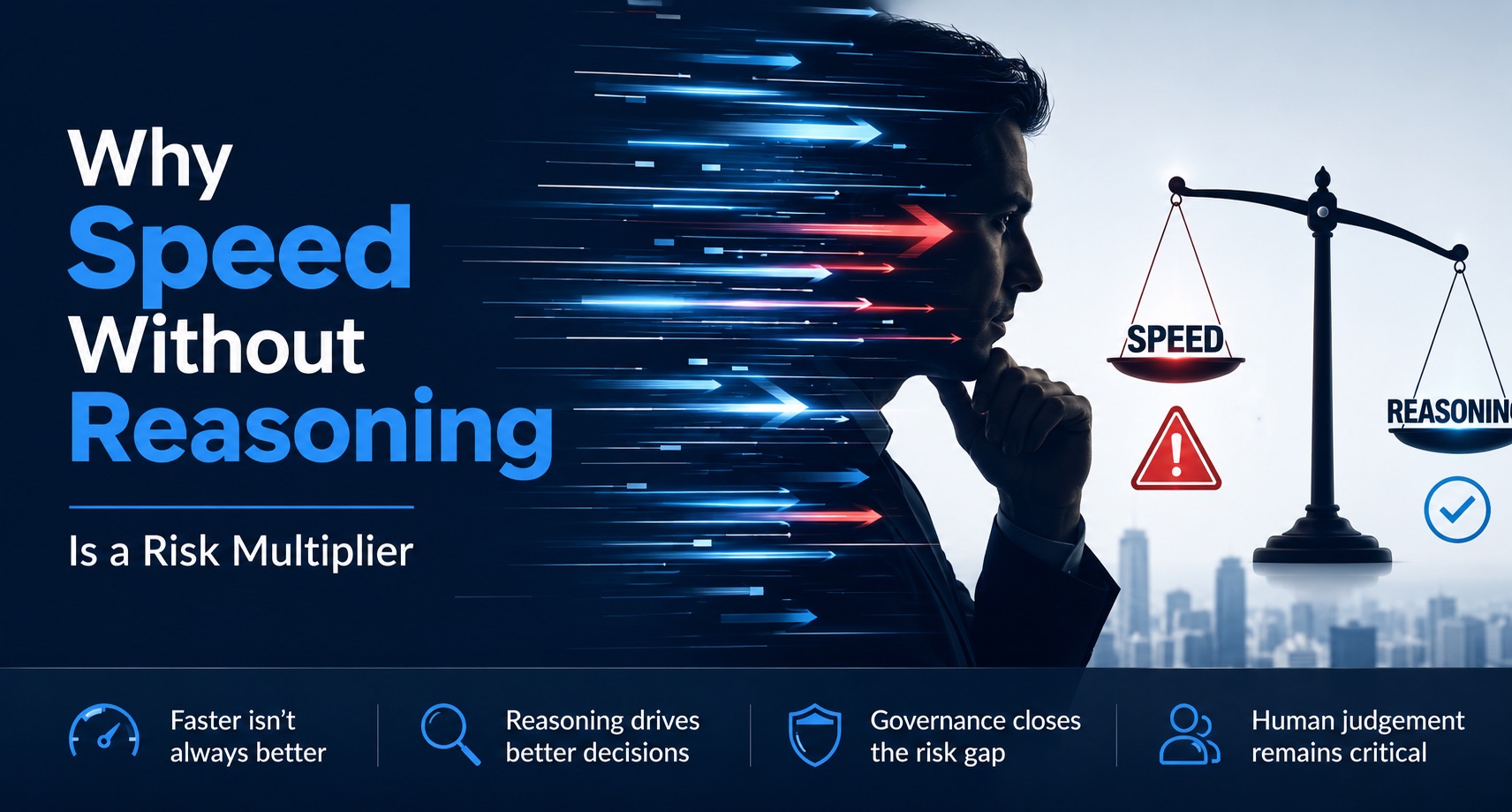
A dangerous assumption is starting to sit underneath a lot of conversations about artificial intelligence. It is the belief that if AI makes a process faster, then the organisation must be improving. On the surface, that sounds sensible. Faster turnaround, lower cost and increased productivity all look like obvious wins.
Yet speed by itself does not prove that a process is better. A flawed workflow does not become safer simply because it moves more quickly. Poor judgement does not become good judgement because it is packaged in a polished AI-generated summary. In some situations, acceleration may simply help an organisation make the same mistakes with greater confidence and less time to notice them.
That is where the real concern begins. AI is not only a tool for automation; it is also a tool that can shape analysis, interpretation and decision-making. It can draft, summarise, classify, recommend and respond at a pace that traditional processes were never designed to handle. Unless the organisation can see how those outputs were formed, the speed may become part of the problem rather than part of the solution.
For that reason, the issue is not whether AI moves quickly. The issue is whether the organisation can still understand the thinking underneath the work. A clean output may look impressive, but if no one can explain the evidence, assumptions or judgement behind it, then the organisation has not created intelligence. It has created momentum without enough control.
Fast Outputs Are Not the Same as Good Decisions
Many organisations are still measuring AI by the speed of its outputs. They ask whether it can write a report faster, summarise a matter faster, triage a request faster or respond to a customer faster. Those questions are understandable because most organisations are dealing with pressure, limited resources and growing volumes of work. Productivity is important, and AI clearly has a role to play.
However, faster production is not the same as better decision-making. A more useful question is whether the output is reliable enough to support action. Did the system use the right information? Were important facts missed? Has it identified legal, ethical, operational or reputational risks? Was uncertainty made visible, or did the answer appear more certain than it really was?
This distinction matters because AI can produce material that looks highly professional while still being incomplete or wrong. A well-written document can hide weak analysis. A confident recommendation can sit on poor assumptions. In high-stakes environments such as law, government, finance, health and regulation, that difference is not academic; it can affect rights, obligations, money, safety and trust.
The risk grows when the output moves faster than the review process. A recommendation may pass through the organisation before anyone has tested its foundation. A summary may be relied upon before anyone has checked the source material. By the time the weakness is discovered, the organisation may already have acted on it.
Speed Compresses the Time Available for Judgement
Traditional workflows often contained natural pauses. A document might move between team members, a recommendation might be discussed, or a decision might sit with a manager before being approved. Those pauses were not always efficient, but they did create moments where people could reflect, challenge and ask whether the work was sound. Friction, although often frustrating, sometimes acted as a form of protection.
AI changes that pattern by compressing the time between input and action. Work that once took days can now be generated in minutes. That can be extremely useful when the process is well governed. It becomes dangerous when the organisation removes the time where judgement used to occur without replacing it with something stronger.
A faster workflow can therefore become less thoughtful if it is not designed carefully. Staff may accept a summary because it sounds authoritative. Managers may approve a recommendation because it appears complete. Teams may move to implementation before they have properly tested the reasoning behind the output.
The question is not whether AI should improve speed. It should. The more important question is whether the organisation has redesigned its review points to match the speed of the technology. Without that redesign, governance falls behind the work, and risk begins to grow in the gap.
The Real Asset Is Not the Output
One common mistake is treating the AI-generated output as the main asset. The report, email, summary, classification or decision note may be useful, but it is only the visible part of the process. What matters more is the thinking that produced it. That is where the value and the risk both sit.
A better organisation will want to know why a conclusion was reached. It will want to understand what evidence supported the answer, what alternatives were considered, and what assumptions shaped the result. It will also want to know where human judgement entered the process and whether that judgement was meaningful. Without that layer, the organisation is left with content but not understanding.
This matters because reasoning is part of institutional intelligence. It explains how an organisation thinks, learns and justifies its actions. When reasoning is captured, decisions can be reviewed, improved and defended. When it is not captured, the organisation may struggle to explain how a particular conclusion was reached.
For this reason, AI governance needs to go beyond tool access and acceptable-use policies. Those controls are necessary, but they do not answer the deeper question. The real challenge is whether the organisation can preserve, test and improve the reasoning layer behind AI-assisted work.
The Risk Is Not AI Replacing People. It Is AI Replacing Thinking.
Much of the public debate focuses on whether AI will replace jobs. That discussion matters, but inside organisations there is another risk that may arrive earlier. AI may not remove the person from the process. Instead, it may reduce the amount of thinking the person is required, or expected, to do.
A human may still click approve, send the email, submit the report or sign off on the recommendation. On paper, that looks like oversight. In practice, it may be little more than procedural involvement if the person has not understood or challenged the reasoning behind the output. Presence alone does not create accountability in any meaningful sense.
Real oversight requires more than a human being somewhere in the workflow. The person must have enough information, skill, time and authority to question the result. They need to see what the system relied on, where uncertainty exists and whether the matter requires escalation. Without those conditions, human review becomes a formality.
This creates a serious governance issue. Formal accountability may remain with the human, while the actual reasoning has been shaped by a system they did not properly interrogate. That gap between responsibility and understanding is one of the areas where AI risk can become difficult to detect until something has already gone wrong.
AI Confidence Can Create Organisational Overconfidence
AI outputs often appear calm, structured and persuasive. They are usually written in a way that feels complete, even when the underlying analysis may be thin. That polish is part of the attraction, but it is also part of the danger. People are more likely to trust something that looks professional.
In busy workplaces, that risk becomes even stronger. Staff are under pressure to move quickly, manage workloads and reduce delays. When a tool provides an answer that looks sensible and saves time, accepting it can feel like the reasonable thing to do. The problem is that ease of use can quietly become ease of reliance.
Good governance should not depend on people remembering to be sceptical every time they receive a polished AI response. The workflow itself should help them pause at the right moments. It should make uncertainty visible, show where information is incomplete and flag higher-risk matters before the output becomes action. Challenge should be built into the process, not left entirely to individual discipline.
Organisational overconfidence begins when leaders assume that cleaner outputs mean better decisions. They may see faster reports, clearer summaries and more consistent drafting and mistake those improvements for stronger judgement. Better presentation is valuable, but it is not the same as better analysis. That difference needs to remain visible.
Speed Without Reasoning Damages Institutional Memory
Every organisation depends on memory. This includes records, policies and documents, but it also includes something deeper: the accumulated understanding of how decisions are made. It includes why particular risks matter, why certain exceptions are allowed and why some matters require greater care. That form of memory is often built slowly through experience.
AI can weaken that memory if it is used only to produce outputs. The organisation may receive the answer without capturing the thinking that led to it. Over time, this creates an odd problem. The organisation may appear more productive while becoming less able to explain why work was done in a particular way.
A better approach is to use AI to strengthen institutional intelligence. The system should help surface assumptions, preserve reasoning, identify patterns and support learning across matters, teams and decisions. Used properly, AI should not just create more content. It should help the organisation remember how it thinks.
That distinction is important. Outputs are often temporary, but reasoning compounds over time. When an organisation captures the thinking behind its work, it can improve its processes, train its people and govern its decisions more effectively. Without that capture, each output stands alone and the organisation loses an opportunity to learn.
Governance Must Move at the Speed of AI
Traditional governance often moves slowly. Policies are drafted, committees meet, risk assessments are completed and reports are prepared. That rhythm may work for some types of organisational change. It is much less effective when AI is operating continuously inside daily workflows.
AI does not wait for a quarterly review cycle. It supports users in real time as they write, assess, classify and decide. Because of that, governance cannot sit entirely outside the workflow as a static document. It needs to be closer to the point where AI is actually being used.
This is where AI telemetry becomes important. Organisations need signals that show how AI is influencing work, when humans intervene, where outputs are changed and where risk thresholds are being approached. These signals are not about surveillance for its own sake. They are about giving leaders a more accurate view of how AI is operating in practice.
Without that visibility, leaders are left relying on assumptions. They may have policies, principles and training materials, but still not know how people are using AI day to day. Living governance means moving beyond static rules and building feedback into the system itself. It allows the organisation to respond to what is actually happening, not just what it hopes is happening.
The New Test: Can You Explain the Decision?
For high-stakes AI use, one of the most practical tests is whether the decision can be explained. Not merely the final output. Not simply the fact that a human approved it. The real question is whether the organisation can explain how the conclusion was reached.
That explanation should include the information used, the assumptions made and the reasoning path followed. It should also show where human judgement entered the process and why the final answer was accepted. If there were alternative options, the organisation should understand why they were rejected. If uncertainty existed, it should be visible rather than buried under confident language.
When an organisation cannot answer those questions, the issue is not only technical. It has a reasoning problem. AI may have exposed that problem, accelerated it or made it easier to scale, but the weakness sits in the decision process itself. That is why explainability should be treated as a practical governance requirement, not just a technical concept.
Being able to explain a decision matters because organisations must justify what they do. They need to show that action was based on evidence, judgement and appropriate review. In an AI-enabled environment, that explanation becomes even more important. Speed should never remove the organisation’s ability to show its work.
Speed Is Not the Enemy
Speed is not the enemy. Used well, AI can reduce backlogs, improve service delivery, remove repetitive tasks and free people to focus on higher-value judgement. It can help organisations respond faster and operate with greater consistency. Those benefits are real and should not be dismissed.
The problem arises when speed is separated from reasoning. Acceleration without judgement is not transformation. It is movement without steering. The organisation may feel more efficient, but it may also be increasing the chance that weak analysis travels further than it should.
Successful organisations will not be defined only by how quickly they automate. Fast outputs will become common. The stronger advantage will belong to organisations that know where judgement matters and how to preserve it inside AI-assisted workflows. That requires design, discipline and governance that operates close to the work.
Those organisations will use AI to make thinking more visible, not less visible. They will treat reasoning as something to be captured, tested and improved. Instead of using AI as a shortcut around judgement, they will use it to support better judgement. That is where the real value sits.
Final Thought
The future of AI in organisations will not be won by whoever produces the fastest output. That capability will become ordinary very quickly. Drafting, summarising, classifying and responding at speed will soon be expected rather than exceptional. The difference will sit somewhere else.
Real advantage will come from the ability to capture and govern the reasoning behind the work. Organisations that understand why decisions were made, what evidence supported them and where uncertainty existed will become stronger over time. They will not only move faster; they will learn more from the work they are doing.
That is why reasoning matters. It carries the judgement, context and experience that make an organisation intelligent. Outputs may solve the immediate task, but reasoning builds capability. In an AI-enabled organisation, that capability may become one of the most important assets of all.
Speed still matters. No serious organisation can ignore effiiency, responsiveness or productivity. But speed without reasoning is not genuine transformation. It is risk moving at scale.